
Hue, the former imperial capital of Vietnam during the Nguyen Dynasty, is home to impressive tombs, temples, and delicious cuisine.
Travel back in time with me in my short escapade to Hue as we visit its major attractions and sample some of its tasty food!
Visiting Hue was part of my 2-week trip in Vietnam from Hanoi to Danang (and Hoi An), with the highlight being a multi-day caving expedition in the world’s biggest cave, Hang Son Doong.
History of Hue
Hue, located in central Vietnam, is a city steeped in history and culture. Once the imperial capital of the Nguyen Dynasty from 1802 to 1945, the city holds a significant place in Vietnam’s history.
Hue’s roots can be traced back to the early 17th century when Nguyen Hoang, a nobleman, established the Nguyen Lords, an influential ruling family. In 1802, Nguyen Phuc Anh declared himself Emperor Gia Long and began the Nguyen Dynasty, with Hue as its capital. During this time, Hue flourished as the political, cultural, and religious centre of Vietnam.
However, Hue’s history is also marked by various wars and conflicts, notably the Vietnam War. It suffered significant damages, but many of its historical sites survived and were later recognised as UNESCO World Heritage Sites. One of the most iconic landmarks is the Hue Imperial Citadel, a complex with impressive palaces, temples, and gates showcasing the grandeur of Vietnamese imperial architecture.
Today, Hue stands as a testament to the country’s rich heritage, with its ancient pagodas, royal tombs, and the picturesque Perfume River adding to its charm. Visitors can explore Hue’s historical sites, experience traditional Vietnamese cuisine, and witness the enduring legacy of this once-mighty imperial capital.
Best Time to Visit Hue
Since Hue is in Central Vietnam, the best time to visit is during the dry season of February to April.
The rainy season begins from September to November, making travel in Central Vietnam risky due to heavy downpours and floods. Central Vietnam suffered one of the worst floods in years in Oct 2020 due to the monsoon and tropical cyclones. People went missing in the Nov 2024 flooding in Hue.
December and January might still see rain episodes from the dwindling rainy season. But this is also the peak holiday season (Lunar New Year Tết and the new year/ year-end celebrations), and prices might soar. Book your accommodations and transport or tour tickets early if you’re visiting!
May to August is summertime and can get extremely hot. I visited Hue in August. Travelling is still doable but be prepared to face a 35°C feeling like 40 °C baking hot sun. I was constantly sipping cold water during my day trip in Hue.
Travelling to the Ancient Capital
As with travelling to other major towns or cities in Vietnam, you have daily buses and trains to and from Hue.
Train
The Reunification Express Railway passes through Hue. If you’re travelling from Hanoi to Hue, it’ll take 14 hours. If travelling from Ho Chi Minh City, buffer at least 20 hours. The cost starts from 500k dong for a one-way ride. Buy your tickets in advance from 12Go or Baolau.
Bus
There are long bus rides from both metropolises to Hue – but why would you do that? I’d rather take a 20-hour train ride than a 22-hour bus ride. At least I could still walk down the corridor or aisle and not worry about the speeding bus.
Bus rides are comfortable for shorter journeys such as from Phong Nha – the adventure town of Vietnam! – to Hue, or Danang/ Hoi An to Hue. The journey takes up to 4 hours.
Flight
Despite its size, Hue has an international airport – Phu Bai International Airport – located south of the central city.
However, international flights are limited to Kunming, China, or Luang Prabang in Laos. Most flights are primarily domestic from Ho Chi Minh City or Hanoi.
Travelling within Hue
We walk everywhere reasonably possible within Hue.
If you do not like walking, Grab works here too, given Hue’s status as a tourist destination. Be reminded, however, that travels to the outskirts for the royal tombs might be slightly more expensive. You may also have difficulty sourcing a Grab ride to the city.
You could pay by cash at the end of your trip, link your credit card to the app so that it auto charges, or charge some money in the app before calling a ride.
Note that Grab checks your identity to make sure you’re credible, so set up an account beforehand. That’s how they maintain a safe network of drivers and passengers.
There are also cyclos/ trishaws around the city that can bring you to your destination. Remember to negotiate and agree on the price before using their services.
Things To Do in Hue
We signed up for a guided tour from Klook, which brought us to several locations at a reasonable price for a comfortable pace, including lunch. Visiting the site yourself is very doable and might even be cheaper if you’re renting a bike or chartering a private car to travel to the tombs on the outskirts.
However, the downside to all these is you may not fully know or appreciate what you’re seeing, and the traffic and weather really aren’t the most comfortable.
Visit Thien Mu Pagoda
The first agenda on our full-day trip was Thien Mu Pagoda by the Perfume River. Also known as Linh Mu Pagoda, Hue’s oldest pagoda was built in 1601 following an interesting legend.
An old lady who frequented the hill where the pagoda is foretold the villagers that a pagoda would be erected on that very spot for the city’s prosperity, somewhat like attracting good feng shui. Strangely, a Lord appeared soon after and followed her plans upon hearing the story. He then named the pagoda Thien Mu, or Heavenly Lady, in honour of the old lady.
As luck would have it, the striking seven-tiered 21m tall pagoda survived all calamity and is regarded as the unofficial icon of Hue.
Other noteworthy or feng-shui-worthy structures include a stela set on the back of a large marble turtle, and a massive bronze bell, said to be the greatest achievement of bronze casting back in those days.
As Thien Mu Pagoda is known as the Capital of Buddhism in Vietnam, it also stores the blue car driven by monk Thich Quang Duc. The monk self-immolated on a street in Saigon in 1963 as an act of protest against the persecution of Buddhists by the South Vietnamese government. The car was later moved to Hue for better protection.
Visiting the pagoda is free; it is open daily from 8 AM to 5 PM. You could travel by the banks of the river via a car or get a boat on the river to reach the pagoda, which was what our tour did to travel to our next destination – The Hue Imperial Citadel.
Cruise over the Perfume River
One ancient scholar remarked that a trip to Hue isn’t complete without a boat excursion on the gentle and aromatic Perfume River. Several artists and poets since a bygone age had penned or painted their thoughts inspired by the river. This love song by Duy Khanh is one fine example.
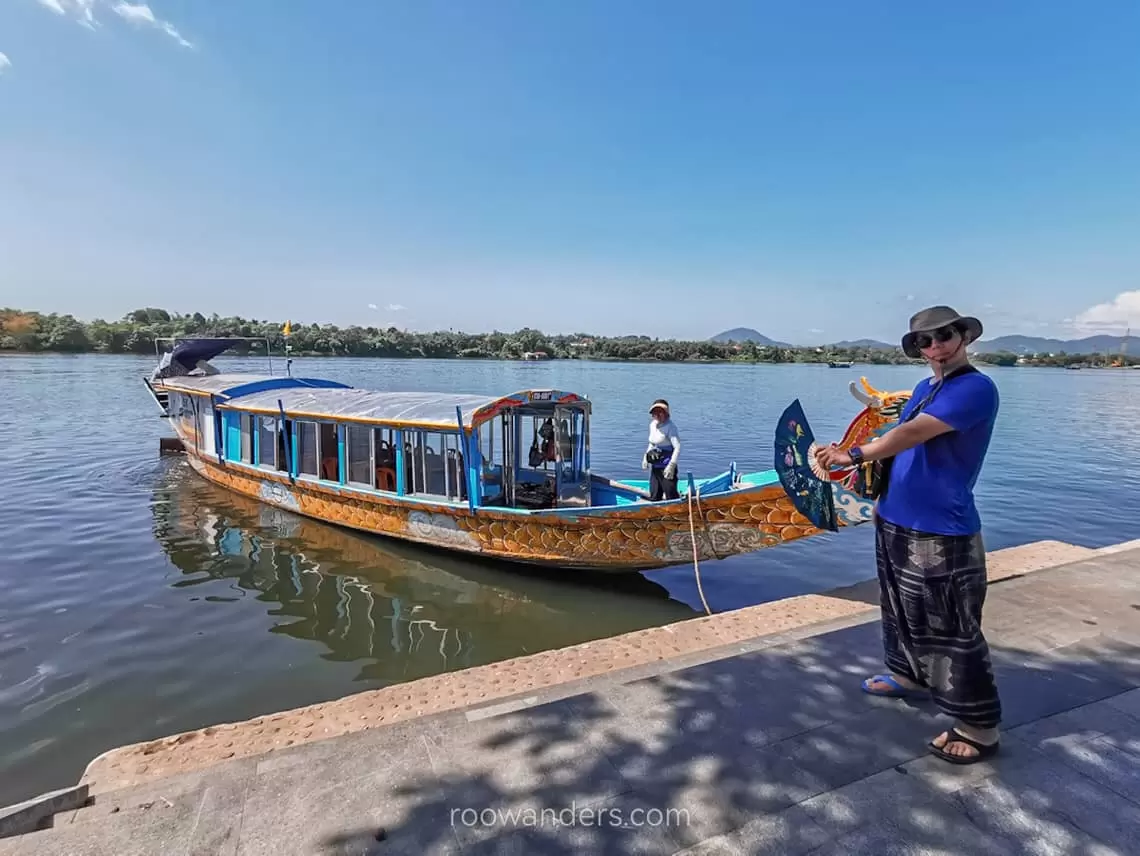
It might have been the weather, the climate, or the time of my visit, as I felt no peace or detected any fragrant aroma. The late morning August sun was too hot, the water too bright from the sun’s rays, and the humidity and hums of the boat made me irritable.
If time were to revert and I became that scholar of the 1600s, I could imagine sniffing the alluring scent of Autumn’s blossom and marvelling at the seven-tiered Thien Mu Pagoda from afar with the setting sun as the backdrop. No tall buildings, noisy boats, or a modern brick bridge. Just a plain old boat sailing idly down the river.
Explore Hue Imperial Citadel
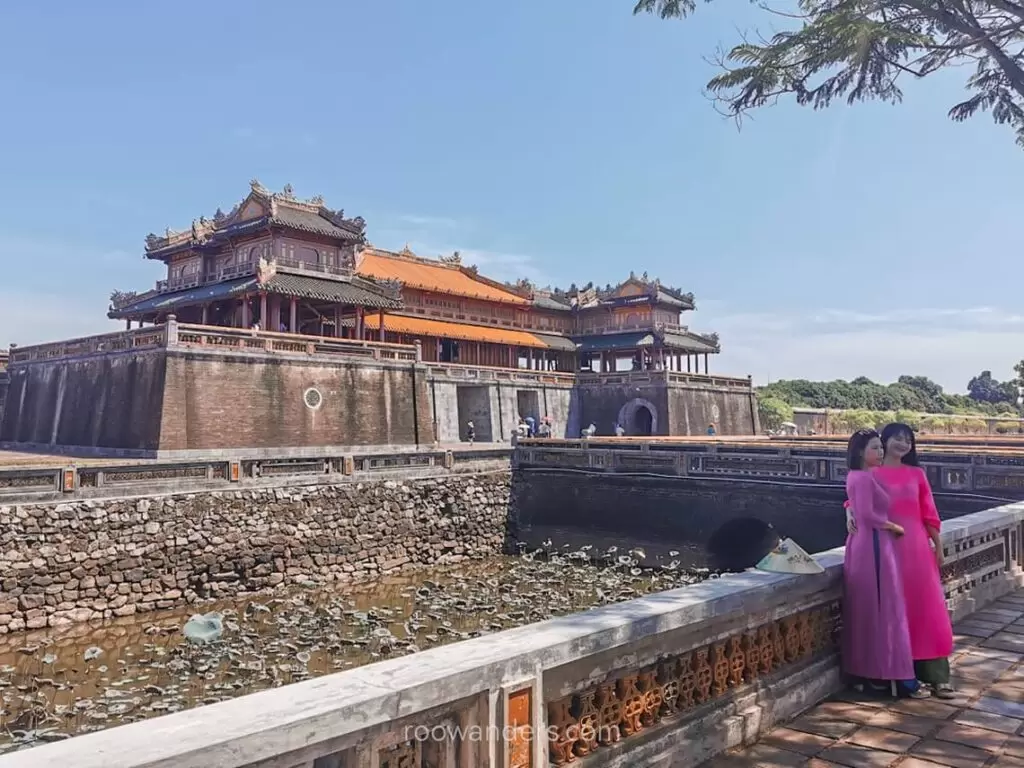
The fortress/ palace of ancient Hue was the capital city of the Nguyen Dynasty for 140 years, from 1805 to 1945. Gia Long, the Emperor who founded the dynasty, sowed the seeds to have the palace built. His son – Emperor Minh Mang – saw its completion in 1832.
The massive complex was a remarkable feat back then. As with other major sites, the palace suffered blows during the Vietnam War. UNESCO World Heritage recognised the citadel in 1993. Since then, the complex has undergone restoration from the effects of war and elemental erosion. Some of the structures were under scaffolds when we visited.
A moat surrounds the grand complex with many temples, pavilions and residences. Half of the complex was dedicated to the administrative force, while the other half was once restricted from public entry, mainly the men, since it houses the Emperor’s residence (and wives).
Entry to Hue Imperial Citadel costs about 230k dong. If you’re planning to visit 2 to 3 other royal tombs on the outskirts of Hue and the citadel, go for the combo pack. Get an audio guide for another 100k dong to fully utilise your trip! Dedicate 2 – 3 hours. The citadel is open every day from 8 AM to 5 PM.
Shop in Dong Ba Market
Have fun getting lost in the oldest and largest market in Hue! I positively meant this as there are loads of sights and scents to take in in this maze of a market. Shopping in an Asian market is always interesting.
Located by the banks of the Perfume River, Dong Ba Market is where the locals do their groceries or shop for clothes or bags. You could get a drink, a dessert or your lunch in the market and people-watch.
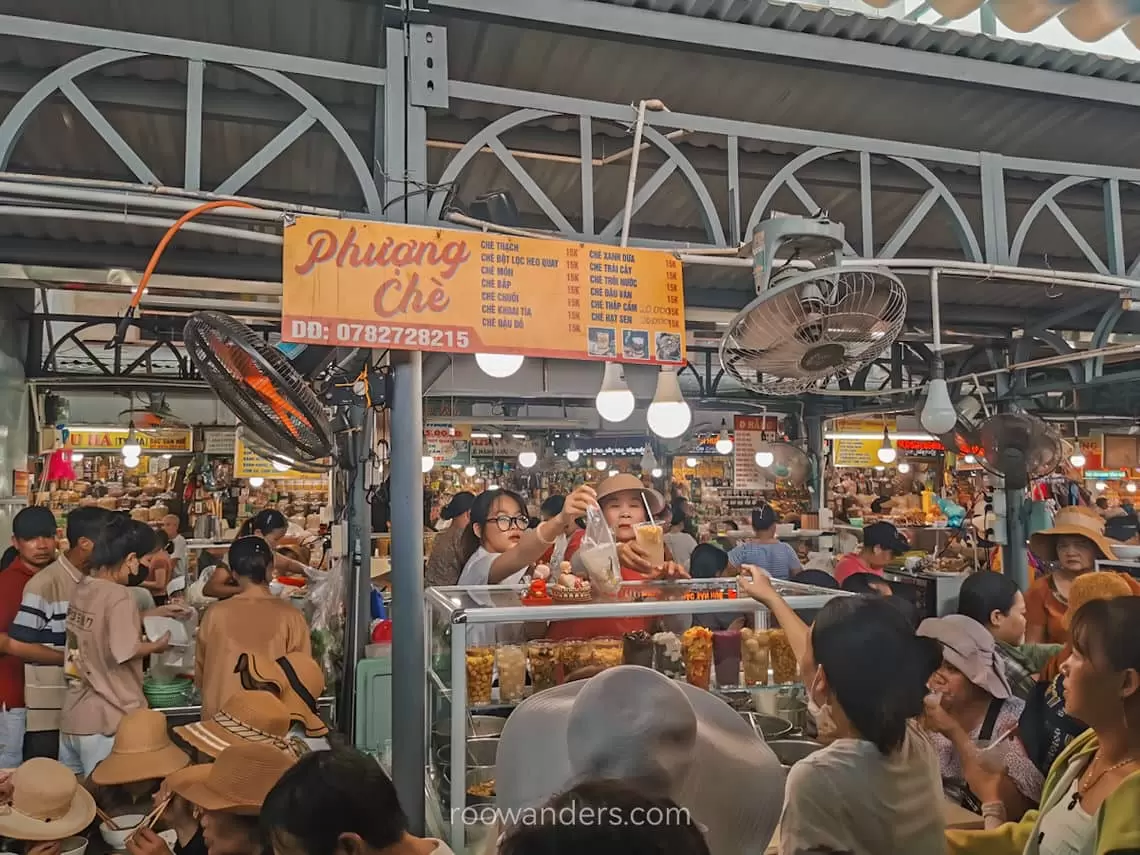
If it’s shopping you’re after, make sure you time your visit in the lull hours after 11 AM. Or be inundated by the grocery shopping crowd who are there to shop for the freshest produce for that day’s meals. The afternoon may be busy too, when locals head in for lunch.
Remember to haggle!
Marvel at the Royal Tombs
The Nguyen Empire had thirteen Emperors and seven tombs housing the remains of nine of those Emperors. Of which, the most widely visited tombs are those of Minh Mang, the second king, Tu Duc, the fourth king, and Khai Dinh, the father of the last king.
Emperor Minh Mang Tomb
Emperor Minh Mang, the son of the first king of the Nguyen Empire, was said to have built his tomb 7 years after his enthronement. The complex was carefully constructed with good feng shui in mind and a strong focus on symmetry.
Within the complex are three gates on the main or holy axis and several other pavilions and temples scattered on both sides of the axis. Emperor Minh Mang’s tomb was carved from a forested part of a hill with artificial lakes dug out to support the feng shui harmony. You need a mountain and some water for extra auspiciousness. ✨
At the end of the complex is a circular gated wall where his body rests. Supposedly.
According to our guide, no one can be sure if the Emperor’s body is truly there after so many years and unrest! The tall trees surrounding the greyish walls after a long walk over the calm lake do add to the peace or eeriness, depending on how you see it.
We also learned that this tomb was supposed to be his ideal retirement house. But as he died before it was completed, his son had him buried there and it became his everlasting tomb.
Take note of the frangipani trees around the main pavilion – Minh Lau Pavilion. They were chosen for their sparse leaves so no assassin could hide in the trees.
The tomb is open every day from 8 AM to 5 PM, and is part of the tomb combo ticket.
Emperor Tu Duc Tomb
We did not visit the tomb of Emperor Tu Duc on our tour due to the lack of time. However, it is possible to visit all three tombs within a day, including the citadel, if you do it yourself or hire a private chauffeur.
Emperor Tu Duc, the fourth king of the Nguyen Dynasty, was the grandson of Emperor Minh Mang. The Emperor led a life of luxury and excess with over a hundred wives and countless concubines but strangely to no offspring. ? It was during his reign that the Nguyen Dynasty fell out of independence and into French control.
To soothe his ill fortunes, the king decided to put his energy into something within his control – his tomb. His tomb was no doubt big. But the labourers who were forced into the act were unhappy. After years of hard toiling under poor conditions, they rebelled, only to be suppressed by the king, ending in a blood bath. Thereafter, the king renamed his tomb from Van Nien Co, or the Palace of Eternity, to Khiem Cung, the Palace of Modesty. ?
Unlike the tombs of other kings, Tu Duc has a royal theatre named Minh Khiem overlooking a lake.
The king might have been extra cautious with his body and afterlife treasures, as they were not found in the main tomb area. Rather, legend has it that the group which laid him to rest in a secret spot were immediately slaughtered after his burial upon their return. Thus no one knows where his body truly is.
As with the other tombs, this tomb is open every day from 8 AM to 5 PM. Get the combo ticket to visit this tomb and others for more value. While it may be nearer to Hue City than the other two tombs, transport is still needed for the commute.
Emperor Khai Dinh Tomb
The tomb of Emperor Khai Dinh is a sight to behold! ?
The final architectural feat of the Nguyen Dynasty is a mesh of Vietnamese and Western art. You could tell that the king is eccentric from the visit. His tomb is unlike those of his ancestors. I draw resemblance to the temples in Chiang Rai.
Feng shui is paramount in such constructions.
As with the other tombs, it was built at the foot of a mountain by the river. However, unlike the others, Emperor Khai Dinh’s tomb has the smallest land space and is supposedly the most expensive to build. During his reign, the Emperor had the gall to increase taxes to fund this extravagance.
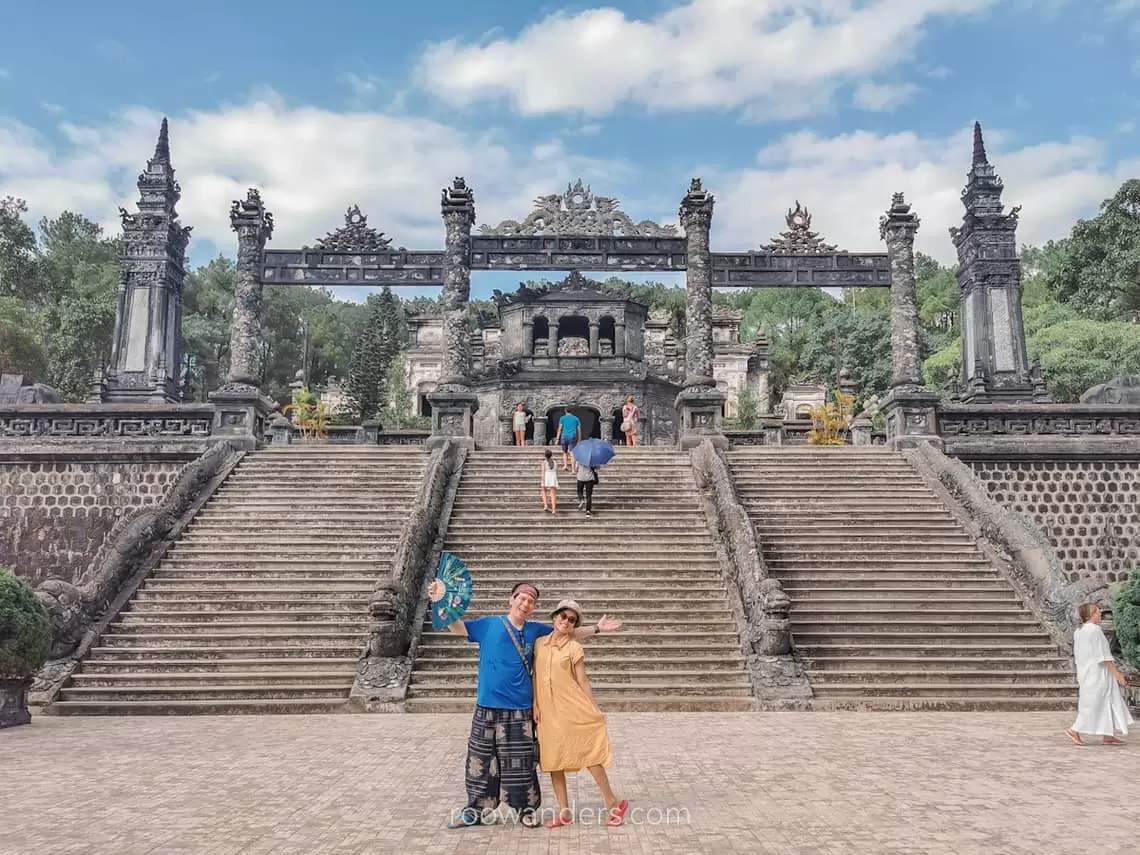
To get to the king’s eternal resting chamber, you’d have to climb over a hundred steps. Notice the dark concrete of the dragons, obelisks and pavilion that give the area a gothic feel.
However, once you’ve stepped inside the main palace – Thien Dinh Palace – an explosion of colours ensued! The interior is richly decorated from the floors to the ceiling with mosaic, gold and elaborate paintings. Nine black dragons swished around atop our heads on the ceilings. Our guide said the painter who did it hung himself upside down from the ceiling and painted with his foot. ?
Emperor Khai Dinh also had two life-sized bronze statues of himself made – one seated on the throne in the main palace and another standing nearby.
The tomb is open every day from 8 AM to 5 PM, and is part of the tomb combo package. It is about 10 km away from Hue City.
Learn the Craft of Incense Sticks
We rounded up the guided tour with a visit to the incense village. Located about 7 km from Hue City, Thuy Xuan Incense Village existed since the Nguyen Dynasty for about 700 years. The village was responsible for supplying incense sticks to the royalties and commoners living around the area.
Incense sticks are made from two different materials – a thin bamboo stick known as the incense core, and an aromatic powder compound known as incense powder. The powder is then mixed with water to form a clay-like texture before it is evenly rolled over each individual incense core to form an incense stick.
A worker can make over 2000 incense sticks within a day, and there are a variety of fragrances from cinnamon to clove and jasmine. Prices start at 50k dong per bundle of sticks.
Savour Hue’s Delicacy
It’s not all just tombs and ancient buildings for Hue. We enjoyed a variety of food during our short stay too.
I probably had two or three bowls of Bun Bo Hue, a beef noodle soup with vermicelli that tasted much more flavourful than the ubiquitous pho. Soupy meals are always my favourite.
However, my travelling partner doesn’t share the same preference as me, so he had Bun Thit Nuong, a dry vermicelli grilled pork salad with peanut sauce as dressing.
Another Hue speciality to try is Nem Lui, a lemongrass pork skewers dish that has to be eaten hot with rice paper and peanut sauce.
We also had the three different royal rice cakes of Hue for lunch during our tour: Banh Nam, a flat rice steamed dumpling, Banh Loc, a flat clear tapioca dumpling, and Banh Beo, steamed rice cakes topped with fried pork skin and shrimp.
Don’t forget to try Banh Khoai – another Hue speciality. Banh Khoai is like Banh Xeo, but smaller and thicker. It’s greasy and crispy from the deep frying and has to be eaten with salad and dipping sauce. I’m not a fan of fried food so this did not make an impression on me.
Food aside, as a fan of delicious coffee, we sampled Ca Phe Muoi, a special salted coffee in Hue. The salt enhances the coffee note and adds some umami and body to the overall experience. Having tried the caramelic egg coffee and coconut coffee of Hanoi, ca phe muoi is now my favourite special coffee in Vietnam!
Some of the eateries we frequented can easily be found on Google’s map. Look for those with high reviews, and you shouldn’t go wrong. There are also many chic cafes to hide from the hot afternoon sun.
We also happened to stumble into a nondescript shop selling cheap Banh Mi while walking back to our hotel. We had no idea what we ordered – a mix of different cuts of meat – and some cold peanut and mung bean drinks. But the place looks popular amongst the locals, especially young Vietnamese.
While strolling down the main road of Hue, we had roadside Vietnamese bean dessert Che Ba Mau to beat the heat.
Soak in the night views of Cau Truong Tien Bridge
Take an evening stroll like the locals by the riverbank of Perfume River, and enjoy the colourful lights of the bridge and the banks.
Catch the sunset over Tam Giang Lagoon
Tam Giang Lagoon, the largest freshwater lagoon in Southeast Asia, is home to numerous wildlife. Take a half-day tour fishing for your seafood dinner over the picturesque sunset view of the lagoon.
Adventures beyond Hue
Take a day tour to the DMZ
If you have additional days to spare, set Hue as your base and explore the demilitarised zone of Vietnam.
Numerous day tours offer this trip and bring you to places like the bridge between the North and South Vietnam, places along the Ho Chi Minh trail, and the Vinh Moc Tunnels (the less popular but equally interesting tunnel vs the Cu Chi Tunnels).
Travel to Phong Nha for caves
Phong Nha is an adventure town in Vietnam. It is home to numerous caves, including the world’s biggest cave, Hang Son Doong.
Most day trips cover 1 – 2 caves like Paradise Cave, Phong Nha Cave and the Dark Cave.
If caves are your thing, head north via bus or train from Hue for an overnight stay in Phong Nha or Dong Hoi. I stayed at Phong Nha for the trip.
Doing it as a full-day tour from Hue is possible, but makes for a long day.
Hike Bach Ma National Park
Enjoy a full-day of forest soaking in Bach Ma National Park. The park is home to over 1400 species of plants and wildlife, and you may just happen to spot a couple of them while trekking to the beautiful Do Quyen Waterfall.
Enjoy serenity at Thuy Bieu Village
Take a half-day trip to Thuy Bieu village for a change in pace. Thuy Bieu is known for its pomelo and grapefruits and was once the place where the Nguyen royals sourced their fruits.
You could still see remnants of the past dynasty such as traditional old houses and sacrificial arena for festivals.
Most tours to this village combine it with cycling and a Vietnamese cooking class.
Cross the Hai Van Pass towards the south
This isn’t so much of a return day trip from Hue, but more of a one-way trip from Hue to Danang or Hoi An.
We travelled on a sightseeing travel bus that brought us to several locations along the way from Hue to Hoi An, including Lang Co Bay, Hai Van Pass, and the Marble Mountains.
Accommodations in Hue
Hue is such a delightful place to stay. Or could it be the boutique I picked which has such hospitable staff? ❤️
Budget backpackers. Budget solo backpackers can look out for Maily Hostel or Chi Homestay for their low-cost dorm beds. Both dorms are in good locations and within walking distance of most attractions within the city.
Affordable hotels. We stayed with the highly hospitable and convenient Soleil Boutique. Breakfast was included, and their complimentary coffee was delicious. 2-star Hue Nino Hotel and 3-star Jade Scene Hotel are two other good budget-y hotels.
Premium hotels. If you’re looking for something more premium, there’s the 4-star White Lotus Hue Hotel, 5-star Senna Hue Hotel and Indochine Palace, which are highly reviewed for their services and prime locations
Conclusion/ Rambles
Hue is a great place to tour for their impressive ancient monuments and temples and delicious food.
The city is convenient to travel around via Grab, and has plenty of good hotels and chill cafes/ eateries. What I truly enjoy in Hue is their huge variety of delicious food with several being specialty only in Hue!
You could easily fill your days in Hue.
We spent one and a half days in total within Hue and found that sufficient. Before Hue, it was a half day spent travelling from Phong Nha to Hue through the DMZ, and after Hue, another half day from Hue to Hoi An. If I had another day to spare, I might have joined the day tour to Bach Ma National Park.
All in all, promise me you’d try Bun Bo Hue and Ca Phe Muoi (on top of the tombs and citadel) before leaving!